
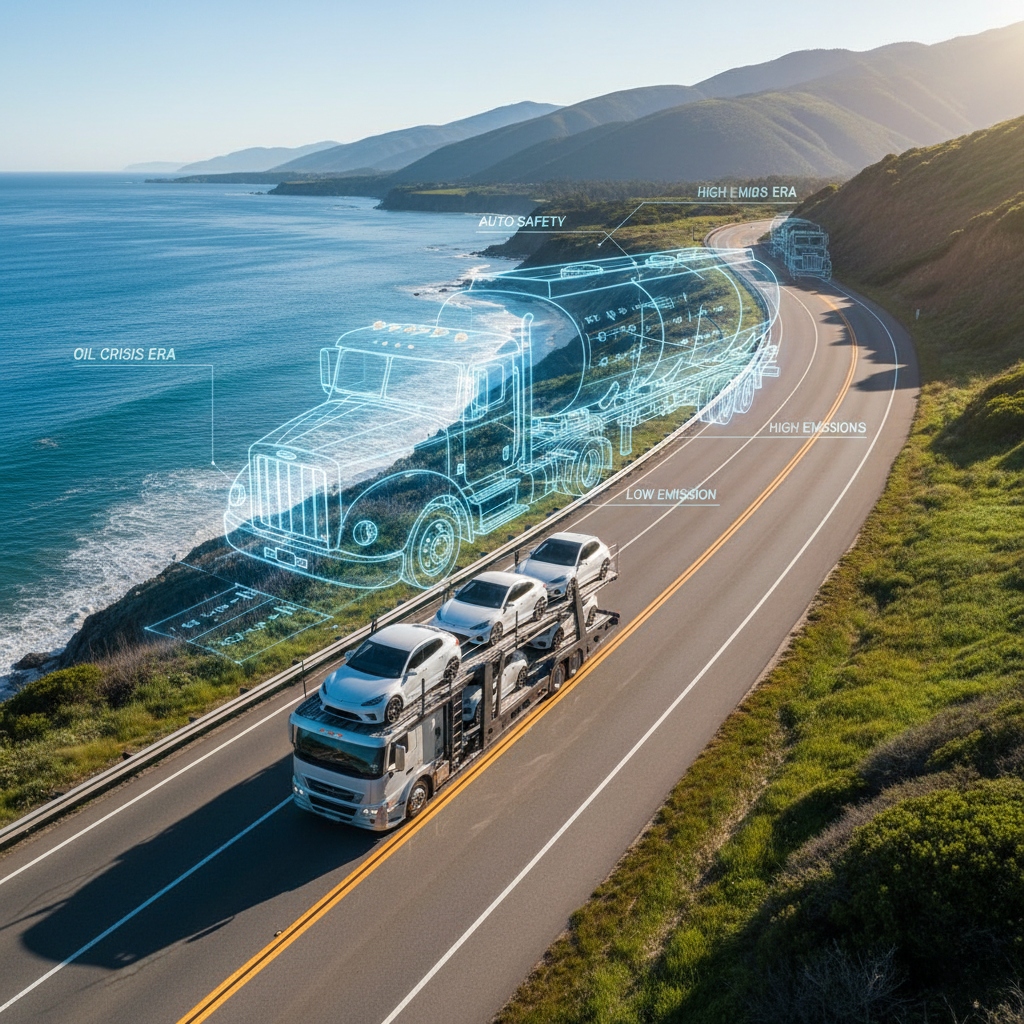
In the high-stakes world of logistics and heavy transport, the line between operational efficiency and public catastrophe is often drawn by the ink of a regulatory permit. While the average consumer rarely pauses to consider the dense legal framework governing the 80,000-pound semi-truck driving alongside them on the interstate, these regulations are the invisible, tireless guardians of public safety. To fully grasp the sophisticated logistics landscape we navigate in 2026, we must look back at the moments when the existing systems were pushed to their breaking point, forcing a total evolution of transport law.
One of the most significant "roots" of modern transport regulation stems from a localized crisis with global implications: the 2015 Refugio oil spill in Santa Barbara County. This event was not just an environmental disaster; it was the catalyst for a decade-long legal transformation. When an underground pipeline owned by Plains All American Pipeline (and serving ExxonMobil) ruptured””releasing over 140,000 gallons of crude oil into the Pacific””it triggered a massive legal battle over "emergency permits."
ExxonMobil sought permits to transport millions of gallons of oil via tanker trucks as an alternative to the shuttered pipeline. The ensuing years of litigation and public debate highlighted a critical tension that still defines the industry today: the balance between economic necessity and the rigid safety protocols required to protect the environment and the public. Today, those lessons are the foundation of every cross-country shipment, from industrial crude to a family”™s primary vehicle. At Shipping a Car Cross Country, we believe that understanding these cross-country transport regulations is vital for any consumer looking for reliable car shipping, forming the core of the car shipping industry growth and market profitability we see today.
The Legacy of the 2015 Exxon Permit Battle: A Lesson in Accountability
The ExxonMobil case served as a watershed moment for regulatory compliance and public safety. The core of the issue was the proposed use of up to 24,800 tanker trucks annually on Highway 101 and State Route 166””winding coastal roads that were never designed for such high-frequency, heavy-load transit. These routes pass through sensitive ecosystems and residential corridors, where a single mechanical failure or driver error could lead to a secondary disaster.
Exxon”™s request for "emergency permits" was viewed by regulators and environmental advocates as a strategic attempt to bypass standard environmental reviews and long-term safety assessments under the guise of an immediate economic crisis. The ExxonMobil 2015 oil spill transport law battles demonstrated that the definition of an "emergency" cannot be expanded to include the degradation of long-term safety standards for the sake of corporate throughput.
This incident exposed the "roots" of modern transport law by forcing regulators to define the absolute limits of "emergency discretion." It established a precedent that a permit is not merely an administrative hurdle; it is a legally binding contract of safety. The courts eventually ruled that economic convenience does not supersede the safety risks posed to the public. For the car shipping industry, this legacy is profound. It proved that "permit-hopping" tactics””where companies might seek loopholes in local or state laws to expedite transit””would no longer stand up to the scrutiny of modern judicial standards. The rigors applied to Exxon”™s tankers have trickled down into car shipping safety standards, ensuring that every carrier moving a high-value, heavy asset over public infrastructure adheres to a standard that prioritizes public safety above all else.
Transitioning to the Modern Era: FMCSA Regulations as a Consumer Shield
Fast forward to 2026, and the lessons of the Santa Barbara spill have been digitized and scaled. Shipping a car across the country is no longer a "handshake and a prayer" industry; it is governed by a complex, data-driven web of Federal Motor Carrier Safety Administration protocols designed to prevent the very risks exposed in 2015. The FMCSA has evolved from a reactive body that investigated accidents after they occurred into a proactive, predictive agency.
For the modern consumer, this means that the carrier hauling their vehicle is subject to "Safety Fitness Determinations" (SFD) that are updated in near real-time, mirroring the high safety standards required for high-net-worth shipping at the corporate level. These are no longer just one-time checks conducted during an initial registration; they are continuous evaluations based on a carrier”™s live performance data. This includes crash history, driver fatigue patterns, vehicle maintenance logs, and even real-time telematic data. This system acts as a digital shield, filtering out high-risk operators before they ever reach your driveway.
The Unified Registration System (URS)
When you ship a car today, you benefit from the fully integrated "Unified Registration System." In the early 2010s, "fly-by-night" carriers could operate under multiple DOT numbers or business names to hide a history of safety violations or insurance lapses. This lack of transparency was a major loophole that put consumers at risk. By 2026, the URS has created a singular, transparent digital identity for every carrier.
This digital footprint allows reputable brokers and regulators to see the "true" history of a carrier instantly. It combines data from the FMCSA, state licensing boards, and insurance providers into a single source of truth. This transparency ensures that only those with a clean, verifiable record of FMCSA compliance 2026 are allowed to handle consumer cargo. It eliminates the "identity-switching" games that once plagued the industry, providing a level of accountability that was impossible a decade ago.
2026 Requirements: The Pinnacle of Digital Compliance
The year 2026 marks the arrival of "Compliance 4.0," characterized by the universal adoption and refinement of Electronic Logging Devices (ELDs) and automated inspection systems. These technologies have moved beyond simple record-keeping; they are now active participants in the safety of every shipment. They provide the empirical data needed to ensure that shipping a car cross country safety is not just a slogan, but a measurable reality.
The Power of ELDs: Eliminating the "Paper Log" Loophole
For car carriers, ELDs are now mandatory and integrated directly into the vehicle's Engine Control Unit (ECU). These devices ensure that drivers adhere to "Hours of Service" (HOS) regulations with 100% accuracy. Historically, driver fatigue was the "silent killer" of the transport industry. Before the ELD mandates for car carriers, drivers often kept "double books"””one for the company and one for the inspectors””to hide the fact that they were driving 15 or 16 hours a day to meet tight deadlines.
In 2026, this is a physical impossibility. The ELD automatically records when the wheels are in motion via the vehicle's transmission. If a driver attempts to exceed the 11-hour driving limit or the 14-hour on-duty window, the device flags the violation instantly. This data is transmitted to the FMCSA via a secure cloud connection. A carrier with frequent HOS violations will find their safety rating plummeted within 24 hours. For a car owner, this means the person behind the wheel of the carrier hauling their vehicle is rested, alert, and legally compliant. There is no longer a "luck factor" in driver fatigue management; there is only data-driven certainty.
Automated Safety Inspections and Level VIII "In-Motion" Checks
Perhaps the most revolutionary shift in 2026 is the implementation of automated safety inspections 2026, often referred to as Level VIII inspections. Traditionally, a truck had to be physically stopped at a weigh station for a manual check””a process that was time-consuming, prone to human error, and often skipped due to limited manpower at state borders.
Today, "Smart Roadside" technology uses high-speed infrared sensors and weigh-in-motion (WIM) scales to inspect a car carrier while it is cruising at highway speeds. These Level VIII "In-Motion" Checks can verify several critical components in seconds:
- Brake Temperature Analysis: Infrared gantries detect disproportionately hot brake drums or rotors, identifying potential "hanging" brakes or imminent failure before the truck enters heavy traffic or mountain passes.
- Dynamic Tire Pressure Monitoring: Acoustic sensors and thermal pads detect under-inflated or over-inflated tires, preventing high-speed blowouts that are a leading cause of multi-car carrier accidents.
- Dimensional and Weight Compliance: Laser arrays measure the height and length of the load, ensuring the carrier won't strike a low-clearance bridge or exceed the structural limits of sensitive infrastructure.
- Real-Time Authority Verification: The truck's electronic transponder communicates with federal databases to ensure its operating authority is active and its vehicle transport insurance verification is up to date.
If a deficiency is detected, the carrier is signaled via an in-cab HUD (Heads-Up Display) alert to pull over at the next designated safety zone. This continuous, invisible inspection regime ensures that only the most mechanically sound trailers””those capable of safely securing multiple high-value vehicles, especially when utilizing enclosed auto transport safety protocols for hazardous road conditions””are allowed to traverse long-haul routes.
Navigating the Complexities of Cross-Country Transport
The "permit-hopping" tactics that once allowed industrial giants to evade oversight have been rendered obsolete by this digital net. For the consumer, the "complexity" of transport regulations is not a burden; it is their greatest ally. When a professional car carrier prepares for a 2,500-mile haul from New York to California, they must navigate a landscape of high-level compliance. This process involves securing several types of emergency transport permits for oversized loads like RV shipping or difficult non-running vehicle transport.
State-Specific Oversize and Overweight Permits
Car carriers are naturally long and often tall, especially when hauling large SUVs or commercial vans. Each state has unique regulations regarding "bridge laws" (the specific distance required between axles to protect road beds) and vertical clearance. In 2026, automated routing software is integrated with state DOT (Department of Transportation) databases. This ensures that a carrier”™s route is pre-cleared for their specific dimensions. It prevents the "emergency" rerouting that historically led heavy trucks onto unsuitable residential roads or under low-clearance bridges””scenarios that frequently resulted in damage to the vehicles on the top deck.
Real-Time Insurance Verification
Insurance in 2026 is no longer a paper certificate that can be forged or may have quietly expired. It is verified via a secure federal API (Application Programming Interface). When a carrier is assigned a load, the dispatch system automatically checks their current coverage limits. If a carrier”™s public liability or cargo insurance lapses for even one minute, their legal authority to operate is automatically suspended in the federal system, and they are flagged for immediate inspection. This vehicle transport insurance verification process ensures that every vehicle we ship is protected by a valid, high-limit policy.
Environmental and Congestion Permits
Direct descendants of the Exxon tanker scrutiny, these permits are now required for carriers moving through specific "Clean Air Zones" or high-congestion metropolitan areas. These regulations ensure that heavy transport does not negatively impact local infrastructure or air quality. They also encourage the use of modern, low-emission, or electric car carriers, which are becoming a standard part of our 2026 logistics fleet. Navigating these requirements requires a level of planning that only the most sophisticated carriers can manage, further filtering the market for quality.
From Industrial Crises to Consumer Peace of Mind
The journey from the 2015 Exxon spill to the automated inspections of 2026 reveals a fundamental truth of the modern age: navigating the web of emergency permits and federal transport regulations is no longer just a concern for oil giants; it is the essential safety net for every car owner. The legal battles of the past have forged the safety standards of the present.
In the past, a consumer might have chosen a car shipper based solely on the lowest price, unaware that a lower price often signaled that a carrier was cutting corners on compliance””skipping expensive permits, overworking drivers, or operating with sub-standard insurance. Today, the digital infrastructure of 2026 makes it nearly impossible for these "outlaw" operators to hide. Transparency has become the industry's new baseline, and safety is a measurable, verifiable commodity.
By investing in reliable car shipping, you are choosing to participate in a system that values accountability. You are ensuring that your vehicle is not just being moved, but is being managed within a framework of total compliance. If you are curious about the costs associated with these high-standard transports, we encourage you to use our pricing guide and calculator to see how we balance competitive rates with absolute regulatory integrity.
Why Verification Matters: The Shipping A Car Cross Country Standard
At Shipping a Car Cross Country, we recognize that we are operating in a new era of logistics where data is just as important as the truck itself. We lead the way in regulatory safety because we understand that the law is not a hurdle””it is a promise of protection for our clients' most valuable assets. We don't just book shipments; we act as a rigorous filter between our customers and the thousands of carriers on the road.
We verify compliance at every level of the journey, utilizing the full suite of 2026 digital tools:
- Real-Time Insurance Monitoring: We do not accept paper COIs (Certificates of Insurance) that can be easily manipulated. Our systems sync directly with insurance databases to ensure every carrier has active, high-limit cargo insurance that covers total loss and specialized damage.
- Granular Safety Rating Analysis: We dive into the FMCSA”™s data-driven metrics to look for patterns. A carrier with a "Satisfactory" rating but a trend of "near-miss" tire violations or brake warnings will not be allowed in our network. We look beyond the surface level to ensure absolute reliability.
- ELD & HOS Verification: We prioritize carriers who utilize advanced telematics and have a proven record of HOS compliance. This ensures that the driver assigned to your vehicle has the rest and focus required for a safe cross-country delivery.
The complex logistics landscape of 2026 requires a partner who remembers the "roots" of transport law””those hard-won lessons from the 2015 Exxon battle””while mastering the high-tech future of car shipping safety standards. When you ship with us, you are benefiting from over a decade of regulatory evolution. We provide the peace of mind required to navigate the complex logistics landscape of 2026, moving your vehicle with the weight of federal compliance and the shield of modern technology behind every mile.
Frequently Asked Questions
Protect Your Vehicle with 2026 Safety Standards
Don't settle for less than total compliance. Experience the peace of mind that comes with industry-leading safety protocols and real-time verification.