
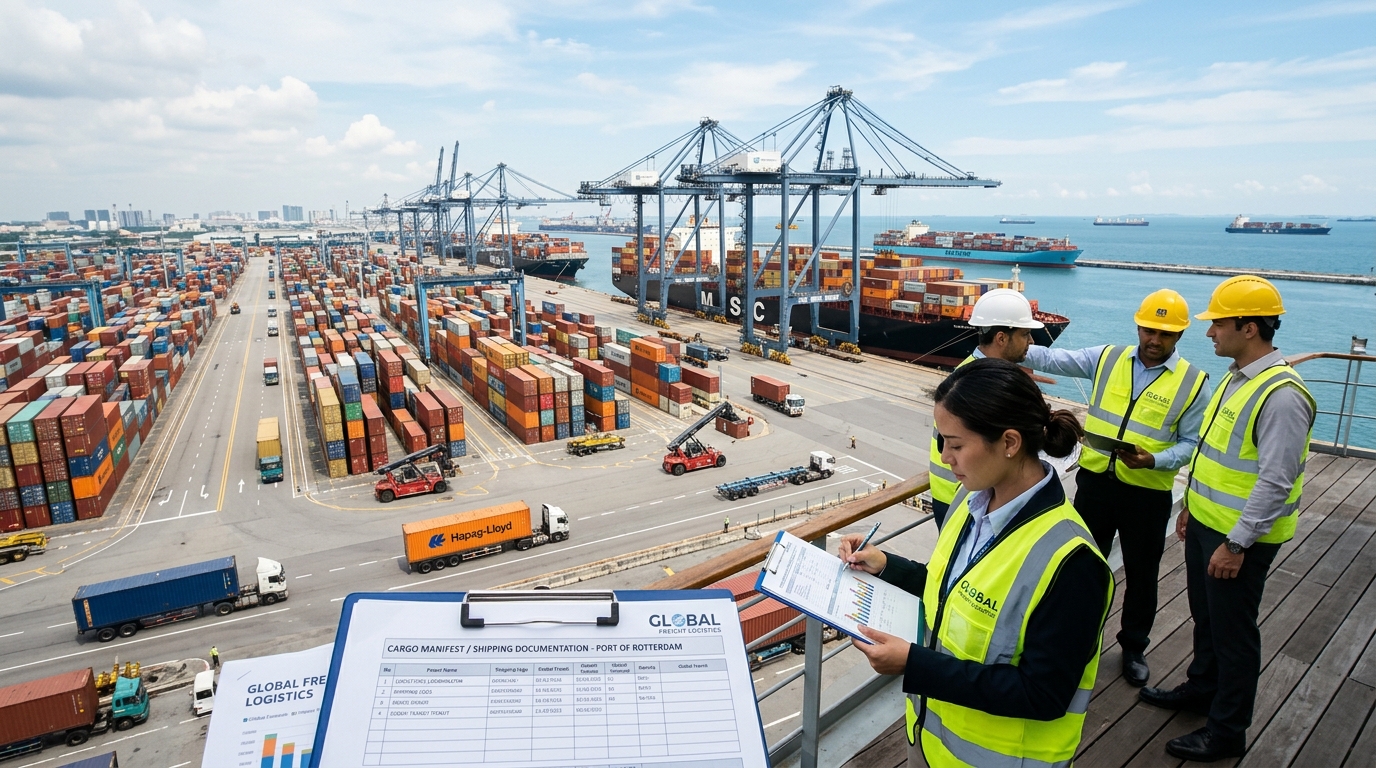
A freight forwarder needs a specific set of documents to legally move cargo across international borders. At minimum, every international shipment requires a Bill of Lading or Air Waybill, a commercial invoice, a packing list, a Certificate of Origin, and customs export and import declarations. Depending on the cargo type and destination country, additional documents such as an insurance certificate, dangerous goods declaration, or export license may also be required. Each document serves a distinct legal or regulatory purpose, and a single missing or inaccurate form can hold a shipment at customs indefinitely.
This guide breaks down exactly which documents freight forwarders prepare, what each one covers, and where errors most commonly occur.
What Is a Freight Forwarder and Why Do Documents Matter So Much?
A freight forwarder acts as an intermediary between the shipper and the various transportation services involved in moving cargo internationally. They do not typically own the ships, planes, or trucks. What they manage is the entire logistics chain, including booking space with carriers, coordinating pickups and deliveries, filing customs declarations, and ensuring every document required by origin and destination countries is accurate and submitted on time.
The distinction between a freight forwarder and a transport broker is worth understanding here. While brokers primarily focus on connecting shippers with carriers, freight forwarders take a more active role in the entire shipment lifecycle, including the documentation process. The difference between auto transport brokers and freight forwarders often comes down to exactly this: forwarders handle the paperwork, compliance, and customs filings that brokers typically do not.
Documents in international freight are legally binding records. They determine whether a shipment clears customs, whether insurance is valid if damage occurs, and whether the correct duties and taxes are assessed. A single error, like a mismatched invoice value or an incorrect HS tariff code, can hold cargo for days or trigger fines.
Core Freight Forwarding Documents for International Shipments
1. Bill of Lading (B/L)
The Bill of Lading is the foundational document in ocean freight. It serves three functions simultaneously: it is a receipt confirming the carrier has received the goods, a contract of carriage between the shipper and the carrier, and a document of title that controls who can take possession of the cargo at the destination.
There are two main types. A Straight Bill of Lading is non-negotiable and names a specific consignee. An Order Bill of Lading is negotiable and can be transferred to a third party by endorsement, which is commonly used in trade finance transactions where banks are involved.
For air shipments, the equivalent document is called an Air Waybill (AWB). Unlike a Bill of Lading, an AWB is always non-negotiable and serves primarily as a receipt and contract of carriage.
2. Commercial Invoice
The commercial invoice is the official financial record of the transaction between the exporter and the importer. Customs authorities in both origin and destination countries use it to determine the declared value of the goods, calculate applicable duties and taxes, and verify that the shipment matches what was declared.
A properly prepared commercial invoice must include the seller and buyer details, a complete description of the goods, the quantity, the unit price and total value, the currency, the country of origin, the Incoterms governing the transaction, and the HS (Harmonized System) tariff code for each product.
Undervaluing goods on a commercial invoice to reduce import duties is considered customs fraud and can result in seizure of the cargo, significant fines, and in serious cases, criminal liability.
3. Packing List
The packing list accompanies the commercial invoice and provides a detailed breakdown of the physical contents of each package, box, or container in the shipment. It includes the number of packages, the gross and net weight of each unit, the dimensions, and the contents of each package.
While the commercial invoice tells customs the value of what is being shipped, the packing list tells them exactly what is physically inside each container. Customs inspectors use the packing list during physical inspections to verify that the cargo matches both the invoice and the shipping declaration.
4. Certificate of Origin
The Certificate of Origin (CO) is an official document that certifies where the goods were manufactured or substantially processed. It is used by importing countries to determine whether preferential duty rates apply under a free trade agreement, whether trade restrictions or embargoes affect the shipment, and to enforce import quotas on goods from specific countries.
Certificates of Origin are typically issued by a Chamber of Commerce in the exporting country. For shipments that qualify under specific trade agreements, such as USMCA (North America) or various EU agreements, a preferential Certificate of Origin must be issued to claim the lower duty rate.
5. Customs Declaration / Export and Import Declarations
Both the exporting country and the importing country typically require a formal customs declaration. On the export side, this is often called a Shipper's Export Declaration (SED) or an Electronic Export Information (EEI) filing in the United States, submitted through the Automated Export System (AES). On the import side, the consignee or their customs broker submits an entry declaration with the relevant customs authority.
Freight forwarders are commonly licensed customs brokers or work in close coordination with them to prepare and file these declarations accurately. The declarations must match the commercial invoice, packing list, and Bill of Lading in every material detail.
6. Letter of Credit and Trade Finance Documents
When a Letter of Credit (LC) is used to secure payment for an international transaction, the freight forwarder plays a central role in ensuring the shipping documents meet the exact conditions set out in the LC. Banks require a precise set of documents, presented in a specific format and within a defined timeframe, before they will release payment to the exporter.
Common documents required under a Letter of Credit include the negotiable Bill of Lading made out to order of the issuing bank, the commercial invoice in the exact format specified, the packing list, the Certificate of Origin, and any other documents the LC specifies, such as an inspection certificate or insurance certificate.
7. Marine or Cargo Insurance Certificate
An insurance certificate or insurance policy confirms that the cargo is covered against loss or damage during transit. While not always legally required, it is strongly recommended for all international shipments and is mandatory under certain Incoterms where the seller is responsible for arranging insurance to the destination port.
The freight forwarder often arranges cargo insurance on behalf of the shipper and issues the certificate as part of the document package. The certificate specifies the insured value, the covered risks, the voyage or transport route, and the name of the insured party.
8. Dangerous Goods Declaration (DGD)
Shipments containing hazardous materials, such as lithium batteries, flammable liquids, corrosive substances, or certain chemicals, require a Dangerous Goods Declaration prepared in accordance with the relevant international regulations. For sea freight, this follows IMDG Code standards. For air freight, it follows IATA Dangerous Goods Regulations.
The DGD must be completed by a certified dangerous goods shipper and accepted by the carrier before the shipment can be loaded. Freight forwarders handling dangerous goods must ensure their staff hold the relevant IATA or IMDG certifications and that the packaging, labeling, and stowage requirements are all met.
Additional Documents Depending on Shipment Type and Destination
Beyond the core document set, many shipments require additional paperwork based on the type of cargo, the destination country, or the specific regulatory environment. Freight forwarders must identify which of these apply before booking the shipment.
| Document | When Required | Purpose |
|---|---|---|
| Export License | Controlled goods, dual-use items, defense equipment | Government authorization to export specific goods |
| Phytosanitary Certificate | Plants, wood, agricultural products | Certifies goods are free from pests and disease |
| Health Certificate | Food products, animal products | Confirms goods meet health and safety standards |
| Fumigation Certificate | Wood packaging materials (ISPM 15) | Confirms wood packaging has been treated |
| Inspection Certificate | Certain commodities; buyer or LC requirement | Third-party verification of goods condition and quantity |
| Import License | Restricted goods in the destination country | Government permission to import specific products |
| ATA Carnet | Temporary exports (samples, exhibitions, equipment) | Allows goods to cross borders without paying duties temporarily |
How Freight Forwarding Documents Apply to Vehicle Shipping
Vehicle shipping across international borders involves the same core document requirements as any other freight, with a few specific additions. When shipping a car internationally, the freight forwarder typically requires the vehicle title or proof of ownership, a bill of sale showing the declared value, the commercial invoice, a packing list or vehicle condition report, and the relevant customs export and import declarations.
For domestic cross-country vehicle transport within the United States, the document framework is simpler. The key document is the Bill of Lading, which the carrier completes at pickup to record the vehicle's condition, and which the consignee references at delivery, a process covered in detail in this vehicle transport cross country guide.
International vehicle exports also require coordination with a reliable freight network that can manage multi-modal logistics, prepare the necessary export filings, and liaise with customs authorities at the destination port. Working with an established freight network ensures that all documentation is prepared correctly from the outset, reducing the risk of delays at the border.
Common Document Errors That Delay International Shipments
Even experienced shippers encounter documentation problems. The following are the most frequently encountered errors that cause customs holds, carrier disputes, or shipment rejections.
Mismatched Information Across Documents
The commercial invoice, packing list, and Bill of Lading must all describe the same cargo using consistent figures. A quantity of 500 units on the invoice that reads as 450 on the packing list creates an immediate discrepancy that customs will flag. Freight forwarders must cross-check all documents before submission.
Incorrect HS Tariff Classification
Every product moving internationally must be assigned the correct Harmonized System (HS) code, a standardized numerical code that customs authorities use to classify goods and determine duty rates. Using the wrong HS code, even unintentionally, can result in the wrong duty rate being applied, penalties for misclassification, or delays while customs investigates the discrepancy.
Missing or Expired Certificates
Certificates of Origin, health certificates, and phytosanitary certificates all have validity windows. An expired certificate submitted with a shipment will be rejected, potentially causing the shipment to be held at the port until a replacement document is obtained from the issuing authority, which can take days.
Incoterm Errors on the Commercial Invoice
Incoterms define which party bears responsibility for freight costs, insurance, and risk at each stage of the journey. If the wrong Incoterm is stated on the commercial invoice, it can create disputes between buyer and seller over who is responsible for duties at the destination, or cause the customs authority to apply the wrong dutiable value to the shipment.
The Role of Digital Documentation in Modern Freight Forwarding
The freight forwarding industry has been moving toward paperless documentation for over a decade, and the shift has accelerated significantly. Electronic Bills of Lading, digital customs filings, and cloud-based document management systems are now standard in many trade corridors.
The benefits are real. Digital documents reduce processing time at ports, eliminate the risk of documents being lost in transit, and allow all parties in the supply chain to access the latest version of a document simultaneously. Many customs authorities now require or strongly prefer electronic submissions over paper-based filings.
For shippers, choosing a freight forwarder that operates with modern document management systems is increasingly important. It means fewer delays, faster customs clearance, and a clearer audit trail if any dispute arises about what was declared, when, and by whom.
Conclusion
Freight forwarding documents are not administrative formalities. They are the legal and commercial backbone of every international shipment, controlling title to goods, determining customs duties, protecting insurance claims, and keeping cargo moving across borders without unnecessary delays. A skilled freight forwarder manages this document chain precisely, ensuring every form is accurate, complete, and submitted on time to the right authorities.
Whether you are shipping general cargo, vehicles, hazardous materials, or agricultural products, understanding which documents are required and why each one matters puts you in a much stronger position when working with a freight forwarder or evaluating whether a shipment is properly prepared for international transit.
Frequently Asked Questions
What is the most important document in freight forwarding?
The Bill of Lading is one of the most important ocean freight documents. It serves as a cargo receipt, carriage contract, and, in some cases, a document of title.
What happens if freight forwarding documents have errors?
Errors can cause customs holds, penalties, cargo delays, extra costs, or disputes. Correcting and resubmitting documents may also delay cargo release.
Does a freight forwarder prepare all the shipping documents?
No. Forwarders coordinate many documents, but exporters usually prepare invoices and packing lists, while authorized bodies issue certain certificates.
What documents are needed to ship a car internationally?
Common documents include the vehicle title, bill of sale or commercial invoice, customs declarations, and insurance documents. Requirements vary by destination.
What is the difference between a Bill of Lading and an Air Waybill?
A Bill of Lading is used for ocean freight and may be negotiable. An Air Waybill is used for air freight and is always non-negotiable.